
On Sept. 11, the American Buddhist Study Center and the New York Buddhist Church will co-host an evening of reflection and gratitude on the 60th anniversary of the unveiling of the Shinran Shonin statue that once stood in a Hiroshima park and now stands in New York City.
Before the statue was brought to New York in 1955 by Rev. Hozen Seki, it witnessed the mass killings and horrific destruction of the atomic bomb in Hiroshima. Then, sadly, the Shinran statue witnessed another horrific act as planes crashed into the World Trade Center in 2001.
The Sept. 11, 2015 ceremony—a celebration and reflection of gratitude for the Japanese men and women who had the vision of bringing Shinran Shonin to America—will begin at 6:30 pm at the New York Buddhist Church with a rededication conducted by Rev. Kodo Umezu, bishop of the Buddhist Churches of America. The keynote speaker is Rev. Dr. Mark Unno from the University of Oregon. There also will be messages from leaders in our interfaith community as well as other distinguished guests. The event is free. For more information, contact the American Buddhist Study Center at 212.864.7424. The full article detailing the history of this Shinran Shonin statue is re-published below.
Shinran Shonin a survivor of World War II and the Atomic Bomb
By Hoshina Seki
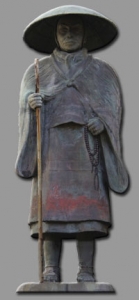
The rededication of the Shinran Shonin statue
This year is an historic year for all Japanese, Japanese Americans, and Americans as it is to remember the 70th Anniversary of the end of WWII and the 60th Anniversary of the unveiling of the Shinran Shonin statue. This statue once stood in a Hiroshima park when the first Atomic Bomb was dropped. Rev. Hozen Seki brought this statue to New York City. The statue witnessed the mass killings and horrific destruction of what mankind created and released on humanity. Then sadly the Shinran statue witnessed another horrific act of death and destruction as planes crashed into the World Trade Center in 2001.
Mr. Hirose Seiichi of Osaka donated the statue. He believed the Shinran statue is an awakening inspiration for peace and tranquility in the world. Shinran is the epitome of wisdom, peace, compassion, and harmony. At the initial dedication, which occurred on September 11, 1955, D.T. Suzuki gave the keynote address;
“The present state of things as we are facing everywhere politically, economically, morally, intellectually, and spiritually is no doubt the result of our past thoughts and deeds we have committed as human beings through the whole length of history, how many years we cannot count, through eons of existence, not only individually but collectively… we are, every one of us, responsible for the present world-situation filled with awesome forebodings.”
On Friday, September 11, 2015 the American Buddhist Study Center and the New York Buddhist Church will be offering an evening of reflection and gratitude on the 60th Anniversary of the unveiling of Shinran Shonin statue.
The evening ceremony will commence at 6:30 pm with a rededication ceremony conducted by Bishop Reverend Kodo Umezu of the Buddhist Churches of America. Our keynote speaker is Rev. Dr. Mark Unno from the University of Oregon. We will hear messages from leaders in our interfaith community as well as other distinguished guests.
History of the statue
Now here is the story on how the statue came to America. It all started back in 1937; Mr. Hirose Seiichi a metal works industrialist upon losing a child became a devout Jodo Shinshu Buddhist. He cast 6 identical bronze statues of Shinran Shonin in travel attire. This is a very important point. They were each around 15 feet tall and weight around 1,300 pounds. The reason for casting 6 statues was one for each character of the nembutsu (Namu Amida Butsu). They were installed between 1937 and 1938 in Osaka, Kyoto, Tokyo, Hiroshima, Niigata prefecture, and in his home town of Kuwana in Mie prefecture.
Mr. Hirose Seiichi was born in 1896 and passed away in 1979 at the age 83.
During the World War II, 3 of the 6 statues were destroyed and the metal was used for the Japanese government war efforts. However, the one on Hijirigaoka hill (Mitaki-cho, Nishi-ku), which overlooks Hiroshima city remained. On August 6, 1945 the first Atomic bomb was dropped on Hiroshima. The epicenter was only two kilometers away from the Shinran Shonin statue (about 1 mile away) received the full blast. Right now you can see red burn marks and there is still a trace of radio activity.
When the Shinran statue was removed from its original site in Hiroshima, Mr. Hirose replaced it with a young Shinran cast. On the 50th anniversary of the Atomic Bombing, the smaller Shinran statue was moved to the Hongwanji Betsuin in the middle of Hiroshima, Teramachi district. Today you can still see on Hijiri-ga-oka hill where the original statue and young Shinran stood as a lasting memorial and remembrance of the Atomic Bomb.
The journey of Shinran Shonin statue coming to America began towards the end of 1954.
On January 23, 1955, Rev. Hozen Seki received this letter from Mr. Hirose
As spring arrives, I would like to say it is my great pleasure to make your acquaintance. I have read your letter of January 12. When I received it, before I opened it I placed it on my Butsu- don as a kind of offering. It was only after that, that I proceeded to open the envelope most respectfully. Regarding the plans you have laid down for the ceremony to be conducted for the Statue, let me say that I am most impressed by them and have nothing but gratitude to express. It has been my long cherished desire to follow through on my plan to have the Statue of the Shonin cross over to America The work to dismantle the statue began in April, 1955. A huge closing ceremony was performed before departing on the cargo ship Kochu Maru (Daido Shipping Company) bound for the United States. The statue was originally donated to the American Buddhist Academy and placed in the Academy’s garden which was a separate organization from the New York Buddhist Church. The Academy was a learning center for Buddhist Studies. Rev. Hozen Seki and his fellow ministers felt New York City needed to have a Jodo Shinshu educational center that teaches Buddhism and peace. Now as September 11, 2015 approaches let us look back on another letter from Mr. Hirose to Rev. Seki in early 1955… Excuse my rough handwriting. The other day, on the 7th there was an article about our Project in the Asahi Shinbun. A lady who lives in a village and who is a devout Shinshu after reading the article expressed. The moment she read it, she immediately put her palms together in Gassho. Our Founder Shinran Shonin is now to journey to distant America, there to preach and eternally pray for world peace.